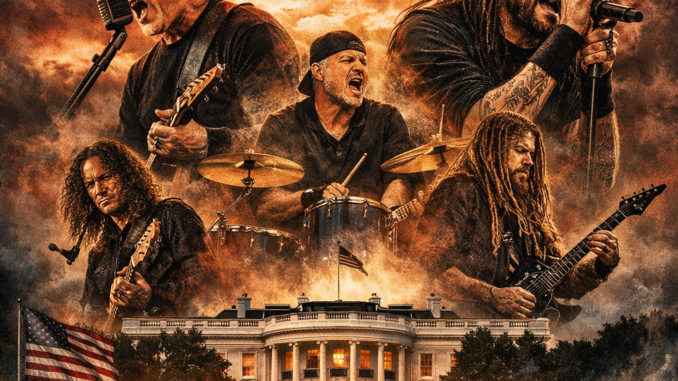
The Sound That Shook the Walls
By 2026, the M72 World Tour had become more than a tour. It was a moving archive of heavy metal history, a rolling thunder that carried four decades of riffs, rebellion, and survival across continents. Every city it touched became part of the story—each crowd another verse, each night another chapter.
The tour had begun years earlier, born from 72 Seasons, an album that looked backward and forward at the same time. It spoke of childhood scars, adult resilience, and the raw forces that shape a life. When Metallica first stepped onto the circular stage in Amsterdam in 2023, the lights overhead spinning like a steel halo, no one knew the journey would stretch this far—or mean this much.
By the time the tour reached its final stretch in 2026, it felt historic. Stadiums were no longer just venues; they were cathedrals of distortion and memory. The in-the-round stage erased distance. Fans didn’t watch Metallica—they stood inside the music. James Hetfield’s voice carried the weight of years, weathered but unbroken. Lars Ulrich played with the restless energy of someone who still believed every night mattered. Kirk Hammett’s solos screamed and soared, while Robert Trujillo’s bass shook the ground beneath thousands of boots.
Each city brought two nights, no repeats. One night might lean into the past—Creeping Death, Master of Puppets, One. The next would surge forward—Lux Æterna, Shadows Follow, If Darkness Had a Son. It wasn’t nostalgia. It was continuity.
Somewhere along the way, Korn re-entered the orbit.
They weren’t strangers. Korn had once carried metal into a new era, bending it with pain, groove, and raw vulnerability. Their music had spoken for a generation that felt unheard. When Metallica and Korn shared festival stages in the years leading up to 2026, fans sensed something building. Not rivalry—respect. Two bands shaped by different eras, standing on the same foundation of heaviness and truth.
Backstage in Berlin, after the second night of a No Repeat Weekend, the idea finally surfaced out loud.
“What if,” someone said, “we made this bigger than a tour?”
The thought traveled fast.
By summer, rumors spread—not of another stadium show, but of something symbolic. Something impossible. A performance that would acknowledge how far metal had come, from garage rehearsals and underground clubs to the center of cultural history.
The White House.
No one announced it. No tickets were sold. It wasn’t about spectacle. It was about recognition.
On a quiet evening in Washington, under tight security and closed gates, a temporary stage was built on the South Lawn. No banners. No fireworks. Just amplifiers, instruments, and a small invited audience—musicians, veterans, artists, and young students who had discovered metal through streaming apps and worn-out headphones.
Metallica opened the night alone.
They played For Whom the Bell Tolls as the sky darkened, the bell toll echoing across manicured grass that had never heard anything like it. They followed with Nothing Else Matters, stripped down, almost fragile. The song floated through the air, reaching places politics never could.
Then Korn joined them.
Jonathan Davis stepped forward, his voice cutting through the silence with a low, trembling growl. Together, the bands tore into a collaborative version of Blind, the groove heavy but controlled, the sound fierce yet deliberate. It wasn’t chaos—it was discipline earned over decades.
For the final song, they chose Enter Sandman.
But it didn’t sound like the radio version. Korn’s influence darkened it, slowed it, twisted it. Metallica adapted without hesitation. Two legacies, interlocked. When the final note rang out, no one cheered at first. They just stood there, absorbing it.
That night wasn’t broadcast. No official recording was released. But the story traveled anyway—passed from person to person, fan to fan, like a myth that didn’t need proof.
When the M72 Tour resumed weeks later in Europe, the energy was different. Fans felt it, even if they didn’t know why. The shows hit harder. The moments between songs felt heavier. It was as if the tour now carried the weight of history itself—not just metal history, but cultural history.
By the final show in London, two nights under the open sky, Metallica closed the circle. The last song wasn’t loud. It wasn’t fast.
It was Fade to Black.
As the lights dimmed and the final chord faded, James Hetfield stepped to the microphone.
“This,” he said simply, “was never just music.”
And somewhere between the roar of the crowd and the quiet that followed, the M72 World Tour became legend—not because of where it played, but because of what it proved.
That heavy music, born in rebellion, had earned its place in history without ever asking permission.
Leave a Reply