The announcement came without warning, slipping into the early hours of a Tuesday morning like a bad omen. A single post appeared on Metallica’s official channels—short, restrained, and unsettling in its vagueness. The 2026 leg of the M72 World Tour was officially terminated. No farewell montage. No press conference. Just four signatures and a sentence that ended with the words: “due to circumstances beyond explanation.”
Within minutes, the internet erupted.
For months, rumors had followed the tour like shadows. Crew members whispered about arenas where amplifiers screamed without being powered on, about lighting rigs flickering in perfect rhythm with songs no one was playing. Fans noticed it too—James Hetfield pausing mid-verse, Lars Ulrich glancing nervously toward the sound booth, Kirk Hammett shaking his head as if listening to something only he could hear.
At first, it was dismissed as exhaustion. After all, Metallica had been touring relentlessly for decades. But the “unusual facts” piled up.
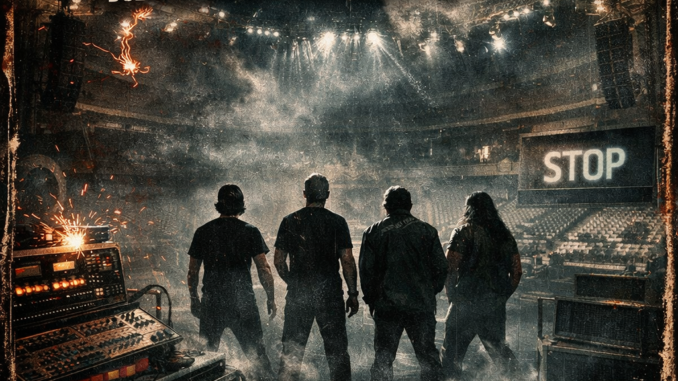
In Berlin, the band walked offstage after thirty minutes when every digital screen behind them went black, displaying a single word in white letters: STOP. In Prague, the crowd felt a low vibration during “One,” a hum so deep it rattled teeth and sent several fans to their knees in tears. Engineers found no seismic activity. No mechanical fault. Nothing.
The final straw came during rehearsals in Glasgow.
As the band launched into “Master of Puppets,” the tempo began to drift—slowly at first, then wildly accelerating. Lars slammed the brakes, shouting that the click track had gone rogue. The technicians swore it wasn’t connected to anything. When the music finally collapsed into noise, the arena fell silent except for a sound that didn’t belong there: a faint echo of the riff, still playing, as if the building itself had memorized it.
That night, the band met alone. No managers. No label reps. Just four men who had faced addiction, loss, and near-death experiences together—and who now shared the same unspoken fear. This wasn’t burnout. This wasn’t technology. Something about the tour itself had turned against them.
In the statement released hours later, Metallica avoided specifics. They spoke of safety. Of responsibility. Of respecting forces they did not yet understand. “Metallica has always pushed boundaries,” it read, “but some boundaries push back.”
Fans were divided. Some demanded answers. Others claimed the band was hiding illness or internal conflict. A smaller group believed the truth was stranger—that decades of sound, volume, and raw human emotion had awakened something old in the concrete and steel of the world’s biggest stages.
Weeks passed. Refunds were issued. Equipment was locked away. And the noise stopped.
But in empty arenas across Europe, security guards still reported hearing it late at night—a distant guitar riff, looping endlessly, as if waiting for four silhouettes to return to the stage.
Metallica was silent.
And for the first time, the world wondered whether silence was the safer choice.
Leave a Reply