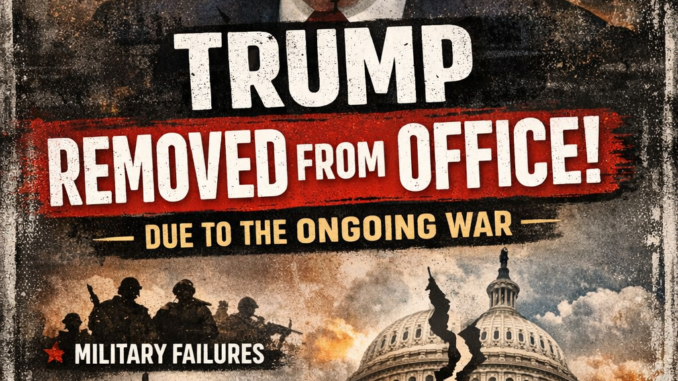
The United States government has made the unprecedented decision to remove President Donald Trump from office due to the ongoing war that has dramatically escalated global tensions. The war, which has stretched the military and economic resources of the United States and its allies, has led to increasing concerns regarding President Trump’s handling of foreign policy, military strategy, and national security. As a result, the government is faced with a complex decision that may reshape the political landscape of the nation.
A Shift in National Priorities
The catalyst for this decision is the prolonged conflict, which has seen the U.S. deeply entangled in a multi-theater war that has impacted both its foreign relations and domestic security. Critics of President Trump’s approach have pointed to his erratic decision-making, lack of long-term strategy, and reliance on divisive rhetoric, which some argue has deepened the nation’s vulnerability.
Over the past year, the war has placed immense pressure on President Trump to deliver results. His initial promises of “America First” and a more isolationist foreign policy have clashed with the realities of global warfare. A series of military blunders and diplomatic failures have exposed the flaws in his administration’s approach. Despite multiple warnings from military advisors and international allies, President Trump continued to push for aggressive actions that have, in many cases, worsened the situation.
A key point of contention has been his handling of international alliances. Trump’s past criticisms of NATO and long-standing relationships with European and Asian powers left the U.S. isolated as it faced mounting pressure from adversaries. As the war intensified, these alliances became critical for survival, but President Trump’s antagonistic stance toward traditional allies caused rifts that left the country struggling to form coherent coalitions.
The Growing Opposition
The decision to remove President Trump has not come easily. Many Republican lawmakers, once staunch allies, have voiced their growing concerns over the president’s ability to effectively lead the country during this time of crisis. As the conflict entered its third year, Trump’s approval ratings plummeted, and widespread dissatisfaction among the electorate became undeniable. Protesters took to the streets, calling for his resignation, while members of Congress openly questioned his competency.
In Congress, the impeachment process was re-initiated, fueled by accusations of mismanagement and failure to protect American interests. This time, however, the push for his removal was broader, as not just Democrats, but also a number of Republicans, began to acknowledge that the president’s leadership had become an obstacle to the nation’s progress. In the wake of critical military losses, economic instability, and an uptick in domestic unrest, these politicians argued that the nation required a steady, unifying leader, one who could restore credibility both domestically and on the international stage.
The Legal and Constitutional Framework
Under the U.S. Constitution, the process for removing a sitting president is well-established. Impeachment, followed by a trial in the Senate, is the primary method. However, the government has now sought to invoke the 25th Amendment, which allows for the president to be removed from office if he is deemed incapable of fulfilling his duties. Though this measure has been rarely used, it provides a more direct route for dealing with presidential incapacity.
The 25th Amendment has historically been seen as a safeguard against situations where a president’s judgment is compromised or if they are unable to carry out the duties of office. In this case, it was invoked due to concerns about President Trump’s mental and emotional fitness to handle the war, which has placed unprecedented stress on his administration. In a highly unprecedented move, both the military and high-ranking officials from various branches of government have endorsed the 25th Amendment action, arguing that it is necessary to ensure the security of the United States.
The Immediate Impact
The implications of this historic decision are profound. The immediate aftermath will likely see Vice President Mike Pence assume the role of acting president, though the political fallout remains to be seen. For the Trump administration’s supporters, this move will undoubtedly be seen as an establishment coup, while opponents will view it as a necessary step to prevent further damage to the country’s global standing.
Moving forward, the nation will have to grapple with the divisive legacy of Donald Trump. His removal from office will mark a turning point in American politics, potentially leading to new alliances, a redefined foreign policy, and a restructured military doctrine. While the decision may help stabilize the country in the short term, it opens the door to new uncertainties, as the U.S. prepares for a future without the leadership of one of the most controversial presidents in history.
In conclusion, the decision to remove President Donald Trump from office due to the ongoing war represents a drastic moment in U.S. history. It reflects the nation’s deepening frustrations with the war and its leadership, as well as the growing realization that bold action is required to preserve American security and global influence. The road ahead will be fraught with challenges, but the removal of Trump from office represents an effort to reset America’s course amidst one of the most tumultuous periods in its history.
Leave a Reply