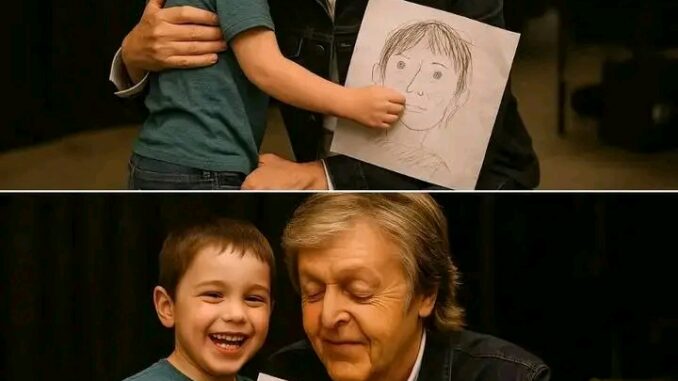
A Sketchpad, A Song, And A Silent Boy: How Paul McCartney Answered a Wordless Call for Connection”, He Couldn’t Speak A Word, But Every Day The Six-Year-Old Boy Drew The Same Face — Paul McCartney’s — In Soft, Shaky Pencil Lines. His Family Sent A Bundle Of Those Drawings To The Venue, Hoping They Might Somehow Reach Him. Backstage After The Concert, Paul Held Them In His Hands, The Edges Smudged With Graphite And Care. He Asked To Meet The Artist. Minutes Later, The Boy Walked In, Eyes Wide, Clutching A Sketchpad. Paul Knelt Down To Meet His Gaze, Then Pulled Him Into A Gentle, Lasting Hug. “Music Is The Language He Chose,” Paul Said Softly To The Family, “And I Understand It.” The Boy Rested His Head On Paul’s Shoulder, And For A Moment, Words Didn’t Matter — Only The Quiet Conversation Between A Melody And A Pencil.👇👇👇
The Quiet Conversation: Paul McCartney and the Boy Who Spoke Through Pencil Lines
In a world that often relies so heavily on words, one six-year-old boy reminded everyone — including one of music’s most legendary voices — that there are other, quieter ways to speak. His name remains undisclosed to protect his privacy, but his story is echoing across hearts and timelines, carried by the quiet force of emotion and artistry.
He hadn’t spoken a single word since birth.
Doctors called it selective mutism, possibly a result of severe anxiety or trauma. Others said it might be part of a broader neurodevelopmental condition. But his family never needed a diagnosis to understand him. They knew the boy had something to say — he just wasn’t saying it the usual way.
Every day, with soft, shaking pencil lines and remarkable consistency, the boy would draw the same face. Not cartoons, not abstract shapes. The face was unmistakably Paul McCartney — the legendary Beatle, the composer of melodies that shaped generations, and the face that seemed to live somewhere deep within the boy’s imagination.
The drawings weren’t traced. They came from memory — from an unknown place of deep, inner connection. Paul’s face always appeared on the same type of paper, drawn with the same careful strokes, always ending with a quiet gaze and a half-smile. Some days, he would draw it once. Other days, a dozen times.
His family didn’t understand the obsession at first. They weren’t Beatles superfans. No constant playlist of Let It Be or Blackbird filled the home. But one afternoon, after months of sketches, they played Hey Jude aloud on a whim.
That was the first time the boy reacted — not with words, but with stillness.
He froze mid-motion, eyes wide, face softening. Then he reached for his pencil and paper and began drawing, the way others might sing along. The music, it seemed, spoke in a frequency only he truly heard.
When they discovered Paul McCartney was touring in their city, the family felt a pull they couldn’t explain. They collected a bundle of the boy’s sketches — dozens of them, the edges soft from little fingers, the graphite slightly smudged — and sent them to the venue in a brown envelope, marked with nothing more than hope and a handwritten note: These are from a boy who speaks only through drawings. He draws your face every day. We don’t expect anything — but if these reach Paul, we believe he’ll understand.
Backstage, after a sold-out performance at the arena, the envelope landed in Paul McCartney’s hands.
The world might know Paul as the master of melody, the legend whose music has crossed cultures and continents. But what often goes unspoken is his quiet compassion — the heart that still beats behind the fame. He flipped through each drawing slowly, pausing, running a thumb along the pencil lines, the small hands that must have held the page.
His eyes, according to crew members, grew misty.
And then he said, simply: “I want to meet the artist.”
Security brought the family backstage.
The boy entered clutching a sketchpad. His eyes — large, watchful, and full of something more than excitement — scanned the room until they landed on the familiar face. Paul knelt down slowly to meet him at eye level, like someone approaching a wild animal with gentleness, reverence, and respect.
The boy didn’t speak. But his body shifted forward, and in a moment that no camera could ever fully capture, he wrapped his arms around Paul McCartney’s neck in a silent, trembling hug.
Paul held him close, whispering, “Music is the language he chose… and I understand it.”
The room held its breath.
It wasn’t about fame or fanfare. There were no flashing cameras, no dramatic music swelling in the background. Just a boy, an artist, and the language that had brought them together — not in sound, but in silence.
Later, Paul asked if he could keep a few of the drawings. The family agreed, of course, tearfully moved. He promised to frame them in his personal collection, saying, “These are as meaningful as any platinum record I’ve received.”
The boy, for his part, continued to sketch even after the encounter — but something had shifted. His lines were stronger. His strokes more confident. It was as if, in being seen, his art had grown roots.
And though he didn’t start speaking in words, he began humming. Quiet, soft, almost inaudible at first — but melodies. Bits of Beatles songs. Mostly “Hey Jude.” Sometimes “Let It Be.” Always with pencil in hand.
The story has since moved millions online — a reminder that communication doesn’t always require speech, and connection doesn’t always demand sound.
Experts have since praised Paul’s response, noting how rare and impactful it is when a public figure recognizes and honors nonverbal communication in such a profound way. For families of children with similar challenges, the moment symbolized hope. Hope that the world might one day listen to the languages of pencils, of silence, of stillness.
There are countless fan stories about Paul McCartney. Tales of kindness, generosity, inspiration. But this one stands apart — not because of celebrity, but because of its simplicity. A boy who couldn’t speak found a way to express himself. And the man he spoke to — across pages and concert halls — chose to listen.
In the end, it wasn’t a concert, a song, or a fan letter that changed that boy’s life.
It was the quiet conversation between a melody and a pencil — and the understanding that music, like love, doesn’t always need words to be heard.
“Take a sad song and make it better,” Paul once sang.
On that night, through trembling graphite lines and a long, gentle hug, one boy did just that.
Leave a Reply