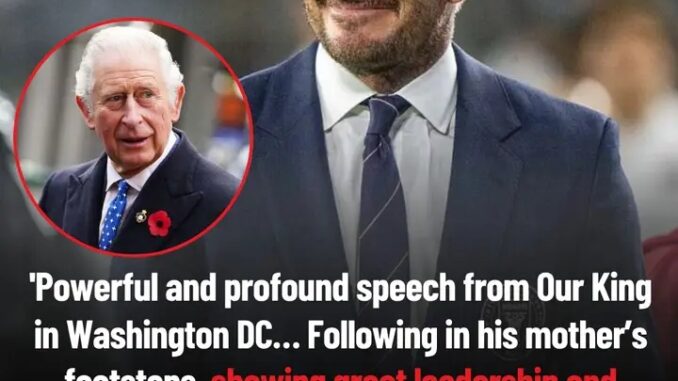
When David Beckham speaks, the world tends to listen—not only because of his legendary football career, but also due to his evolving role as a global cultural figure and ambassador. His recent praise for King Charles III following the monarch’s address in Washington, D.C. has once again placed him at the intersection of sport, diplomacy, and public influence.
Beckham described the King’s speech as “powerful and profound,” emphasizing how deeply it resonated with audiences across borders. Delivered on an international stage, the address carried both symbolic and practical weight, reflecting not only the United Kingdom’s diplomatic tone but also the King’s personal approach to leadership. For Beckham, who has long maintained a close affinity with the Royal Family, the moment was particularly meaningful.
In his remarks, Beckham highlighted how King Charles III is steadily carving out his own identity as monarch while still honoring the enduring legacy of Queen Elizabeth II. The late Queen’s reign was defined by consistency, grace, and an unwavering sense of duty—qualities that Beckham suggested are clearly influencing the current King’s approach. However, he also pointed out that Charles brings a distinctive voice to the role, blending tradition with a more contemporary tone.
The Washington address itself was notable for its balance. It carried the seriousness expected of a global leader while also weaving in moments of elegance and subtle humor. Beckham was quick to note this duality, praising the King’s ability to connect with his audience on multiple levels. In an era where public speeches are often dissected for tone and authenticity, such a balance is not easily achieved.
For Beckham, who has represented England on the world stage and later transitioned into humanitarian and ambassadorial roles, the importance of communication cannot be overstated. His appreciation for the King’s speech reflects his own understanding of how words can shape perception, inspire unity, and foster international cooperation. It is perhaps this shared awareness that underpins his admiration.
Beyond the speech itself, Beckham’s comments also underscore his longstanding relationship with the Royal Family. Over the years, he has attended numerous royal events, supported charitable initiatives aligned with royal causes, and publicly expressed respect for the institution. His tribute following Queen Elizabeth II’s passing—where he famously queued for hours with members of the public to pay his respects—cemented his reputation as someone who values tradition and national identity.
His latest praise for King Charles III can therefore be seen as part of a broader narrative. It reflects continuity—not only within the monarchy but also within Beckham’s own public life. As someone who has transitioned from athlete to global statesman-like figure, his voice carries a unique blend of relatability and authority.
The choice of Washington, D.C. as the setting for the King’s address further amplified its significance. As a hub of political power and international diplomacy, the city provided a fitting मंच for a speech intended to resonate beyond national boundaries. Beckham noted that the message delivered was not just for those in attendance, but for the world at large—a sentiment that highlights the increasingly global nature of modern leadership.
What stood out most to Beckham was the sense of purpose behind the King’s words. He described the address as not only significant but also carefully crafted to inspire reflection and dialogue. In a time marked by geopolitical tensions and shifting alliances, such speeches play a crucial role in shaping the narrative and fostering understanding.
Beckham’s endorsement also carries weight because of his own credibility on the international stage. Having played for clubs in multiple countries and served as a global ambassador for various causes, he understands the nuances of cross-cultural communication. His recognition of the King’s efforts therefore adds an additional layer of validation to the speech’s impact.
Ultimately, Beckham’s praise highlights more than just admiration—it reflects a broader appreciation for leadership that combines tradition with adaptability. In King Charles III, he sees a figure who is not only following in the footsteps of Queen Elizabeth II but also forging a path that speaks to the challenges and opportunities of the present day.
As the world continues to watch the evolution of the British monarchy, voices like David Beckham’s offer valuable insight into how these changes are perceived beyond royal circles. His description of the King’s address as “powerful and profound” captures a moment that, while rooted in ceremony, carries real-world implications.
In an age where influence extends far beyond formal titles, the convergence of figures like Beckham and King Charles III illustrates the enduring power of thoughtful leadership and meaningful communication.
Leave a Reply